
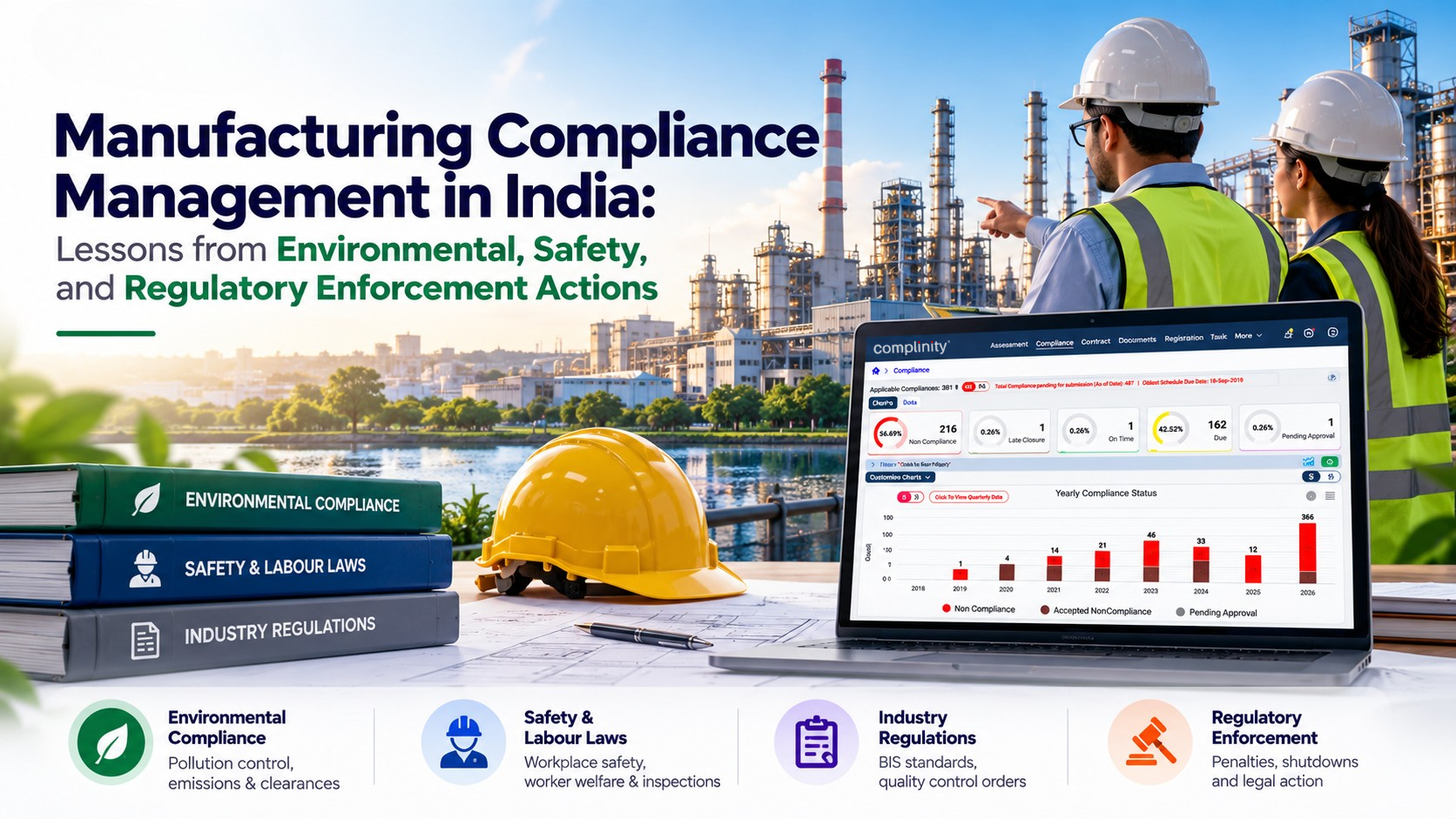
Manufacturing Compliance Management in India: Lessons from Environmental, Safety, and Regulatory Enforcement Actions
Why Compliance Is Critical in Manufacturing
Manufacturing is one of the most compliance-intensive industries in India.
Manufacturers must comply with environmental regulations, factory safety requirements, labour laws, product quality standards, hazardous waste management rules, and corporate governance obligations. Failure to comply can result in plant shutdowns, penalties, license cancellations, legal proceedings, and reputational damage.
Recent enforcement actions across India show that regulators are no longer focusing only on paperwork. They are actively monitoring workplace safety, environmental impact, product quality, and operational compliance.
For manufacturers, compliance is no longer a back-office activity-it is a business continuity requirement.
Major Manufacturing Compliance Failures in India
1. Sterlite Copper: Environmental Non-Compliance and Plant Closure
One of India’s most significant manufacturing compliance cases involved the Sterlite Copper plant in Tamil Nadu.
Following years of allegations regarding environmental violations and pollution concerns, regulatory authorities initiated action against the facility. The Supreme Court had earlier imposed environmental compensation of ₹100 crore, while subsequent proceedings ultimately led to the continued closure of the plant.
The case attracted national attention due to concerns surrounding pollution control, environmental clearances, and community impact.
Compliance Lesson: Environmental compliance cannot be treated as a periodic exercise. Manufacturers must continuously monitor emissions, maintain regulatory approvals, and proactively address environmental risks.
2. LG Polymers: Industrial Safety Failure with Human Consequences
In May 2020, LG Polymers’ Visakhapatnam facility experienced a styrene gas leak that affected thousands of residents and resulted in multiple fatalities.
Investigations by regulatory authorities and the National Green Tribunal (NGT) highlighted concerns around chemical storage, process safety, risk management, and emergency preparedness. The NGT directed the company to deposit ₹50 crore as an interim measure while investigations continued.
The incident became one of India’s most discussed industrial safety failures.
Compliance Lesson: Safety compliance extends beyond legal obligations. Strong process safety management, emergency response planning, and continuous risk assessments are critical to protecting lives and business operations.
3. BIS and Quality Control Order (QCO) Compliance: A Growing Manufacturing Risk
The Indian government has significantly expanded mandatory Quality Control Orders (QCOs) across multiple manufacturing sectors.
Products covered under QCOs require compliance with Bureau of Indian Standards (BIS) certification requirements before they can be manufactured, imported, sold, or distributed. Non-compliant manufacturers face product seizures, sales restrictions, market withdrawal, and regulatory action.
Industries affected include electrical equipment, chemicals, consumer goods, industrial products, electronics, and construction materials.
Compliance Lesson: Product compliance is becoming a major business risk. Manufacturers must continuously monitor BIS certification requirements and evolving quality regulations.
4. Pollution Control Board Enforcement Actions
Across India, Pollution Control Boards regularly issue closure notices, suspension orders, and penalties against manufacturing units that fail to comply with environmental regulations.
Common violations include:
- Operating without Consent to Operate (CTO)
- Exceeding emission limits
- Improper hazardous waste disposal
- Water pollution violations
- Non-compliance with environmental monitoring requirements
Many manufacturing units face production disruptions due to delays in environmental approvals and reporting obligations.
Compliance Lesson: Environmental compliance failures often result in operational shutdowns, making proactive monitoring essential for uninterrupted business operations.
5. Factory Safety and Labour Compliance Violations
Industrial accidents continue to highlight the importance of workplace safety compliance.
Manufacturers are required to comply with safety regulations covering machinery operations, worker welfare, occupational health, hazardous processes, emergency preparedness, and workplace conditions under factory and labour laws.
Regulatory inspections frequently identify deficiencies in safety procedures, documentation, worker training, and risk management systems.
With the Occupational Safety, Health and Working Conditions Code increasing focus on workplace safety, enforcement is expected to become more stringent.
Compliance Lesson: Safety compliance should be integrated into daily operations rather than managed solely during inspections or audits.
How Manufacturers Can Avoid Similar Penalties
Manufacturing organizations should focus on five key compliance areas:
- Environmental approvals and pollution control compliance.
- Factory safety and occupational health programs.
- Product quality and BIS certification requirements.
- Labour law and workforce compliance obligations.
- Continuous monitoring of regulatory updates and compliance deadlines.
The most successful manufacturers build compliance into operational processes rather than treating it as a separate function.
How Compliance Management Software Helps
AI-powered Compliance Management Software helps manufacturers centralize compliance obligations, monitor legal updates, automate reminders, manage multi-location compliance requirements, and maintain audit-ready records.
Instead of relying on spreadsheets and manual trackers, manufacturers gain real-time visibility into compliance status across plants, departments, and locations.
This improves accountability, reduces compliance risks, and helps organizations respond proactively to regulatory changes.
Key Takeaways
- Manufacturing is one of India’s most heavily regulated industries.
- Environmental compliance, workplace safety, and product quality remain major enforcement priorities.
- Compliance failures can lead to penalties, shutdowns, legal proceedings, and reputational damage.
- Regulatory expectations continue to increase across manufacturing sectors.
- Compliance Management Software helps manufacturers manage compliance proactively and efficiently.
FAQs
What are the biggest compliance risks in manufacturing?
Environmental compliance, factory safety, labour laws, hazardous waste management, product quality standards, and regulatory reporting.
Why is environmental compliance important for manufacturers?
Environmental violations can result in plant closures, penalties, operational disruptions, and legal action.
What is BIS certification?
BIS certification ensures products meet prescribed Indian quality and safety standards.
What is a Quality Control Order (QCO)?
A QCO makes compliance with specific BIS standards mandatory for designated products.
Why is workplace safety compliance important?
Workplace safety regulations protect workers, reduce accidents, and help organizations avoid regulatory action.
How does Compliance Management Software help manufacturers?
It automates compliance tracking, legal update monitoring, audit readiness, reporting, and risk management.
Contact us
Complinity, India’s Leading Compliance Management Software, helps companies manage their statutory and regulatory compliances on a secure software platform.
We are currently serving companies like Max Hospital, JBM Group, TVS Credit, DCM Shriram, Oberoi Hotel, M3M apart from 1500+ Companies across 100+ industry verticals.
If you wish to know more how Complinity can help your organization minimize non-compliance risks, click the link below.

 Thank You for your interest in Complinity. Your CV has been forwarded to HR.