
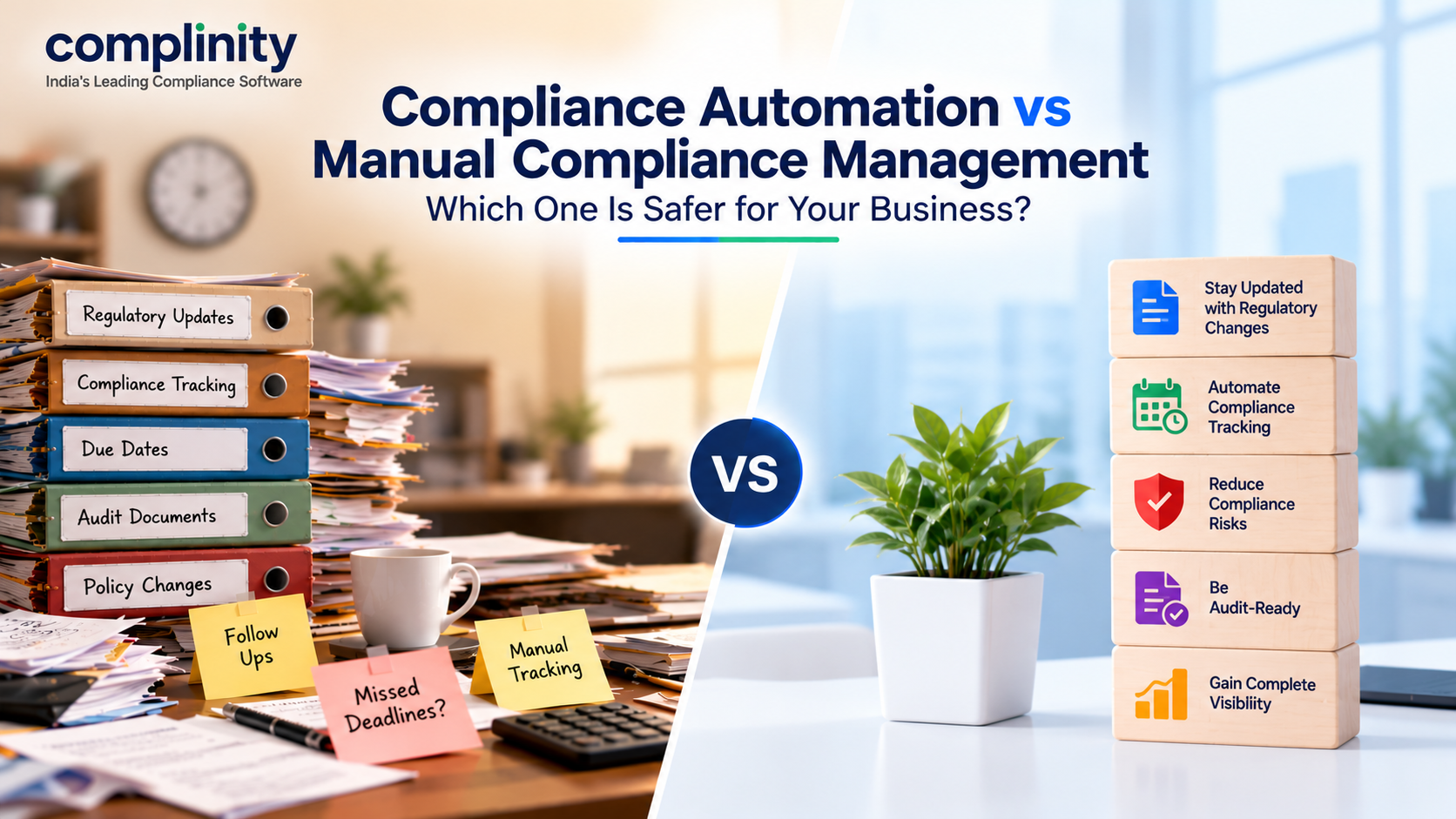
Compliance Automation vs Manual Compliance Management: Which One Is Safer for Your Business?
Why This Debate Matters in 2026
Every business wants to stay compliant. The real challenge is deciding how compliance should be managed.
Many organizations still rely on spreadsheets, email reminders, shared folders, and manual follow-ups to track compliance obligations. Others are investing in Compliance Management Software and AI-powered automation to streamline the process.
Both approaches aim to achieve the same goal-regulatory compliance. However, as compliance requirements become more complex, the difference between the two approaches is becoming increasingly significant.
The question is no longer whether compliance should be managed.
The question is whether manual processes can keep up with today’s regulatory environment.
Understanding Manual Compliance Management
Manual compliance management relies on human intervention for tracking, monitoring, reporting, and documenting compliance activities.
Common tools include:
- Excel spreadsheets
- Email reminders
- Shared drives
- Physical documentation
- Calendar-based tracking
While this approach may work for small organizations with limited compliance obligations, it becomes increasingly difficult as businesses grow.
Manual systems often create challenges such as:
- Missed deadlines
- Data entry errors
- Lack of visibility
- Dependency on individuals
- Difficult audit preparation
The bigger the compliance landscape, the harder manual tracking becomes.
What Is Compliance Automation?
Compliance automation uses technology and AI-powered Compliance Management Software to automate compliance-related activities.
Instead of manually tracking obligations, automated systems can:
- Monitor compliance deadlines
- Generate reminders and escalations
- Track regulatory updates
- Maintain audit trails
- Centralize compliance records
- Generate reports automatically
The objective is not to replace compliance professionals.
The objective is to eliminate repetitive administrative tasks so compliance teams can focus on risk management and decision-making.
Compliance Automation vs Manual Compliance Management
Regulatory Change Monitoring
- Manual Approach:
Teams must continuously monitor government websites, notifications, circulars, and regulatory announcements. - Automated Approach:
AI-powered systems can monitor regulatory updates and alert relevant stakeholders when changes occur.
Winner: Compliance Automation
Compliance Tracking
- Manual Approach:
Deadlines are managed through spreadsheets, emails, and individual follow-ups. - Automated Approach:
Systems automatically track compliance obligations and generate reminders before deadlines.
Winner: Compliance Automation
Accuracy and Reliability
- Manual Approach:
Human errors, missed entries, and outdated records can create compliance gaps. - Automated Approach:
Automation reduces dependency on manual intervention and improves consistency.
Winner: Compliance Automation
Audit Readiness
- Manual Approach:
Audit preparation often requires collecting records from multiple sources. - Automated Approach:
Documents, evidence, and compliance records are stored centrally and remain audit-ready.
Winner: Compliance Automation
Scalability
- Manual Approach:
Managing compliance across multiple locations becomes increasingly difficult. - Automated Approach:
Compliance obligations can be tracked across departments, plants, offices, and jurisdictions from a single platform.
Winner: Compliance Automation
Cost Perspective
At first glance, manual compliance appears cheaper because there is little technology investment.
However, organizations often underestimate the cost of:
- Missed deadlines
- Compliance penalties
- Audit inefficiencies
- Employee time spent on tracking activities
- Regulatory risks
Compliance automation reduces these hidden costs while improving operational efficiency.
Which Approach Is Safer?
The answer depends on the complexity of the business.
For a small organization managing a limited number of compliance obligations, manual tracking may still be manageable.
However, for organizations operating across multiple locations, entities, or regulatory frameworks, compliance automation provides a significantly safer and more scalable approach.
Automation offers:
- Better visibility
- Faster response to regulatory changes
- Reduced human error
- Stronger audit readiness
- Improved accountability
Most importantly, it enables organizations to move from reactive compliance management to proactive compliance management.
In a regulatory environment where penalties, scrutiny, and reporting requirements continue to increase, that shift can make a significant difference.
Key Takeaways
- Manual compliance management becomes difficult as compliance complexity increases.
- Compliance automation improves accuracy, visibility, and scalability.
- AI-powered systems help organizations monitor regulatory changes and compliance obligations more effectively.
- Automated compliance management reduces dependence on spreadsheets and manual follow-ups.
- Businesses seeking long-term compliance resilience are increasingly adopting Compliance Management Software.
FAQs
What is compliance automation?
Compliance automation uses software and AI to automate compliance tracking, monitoring, reporting, and documentation activities.
Is manual compliance management still effective?
It may work for organizations with limited compliance obligations, but it becomes difficult to manage as regulatory complexity increases.
How does compliance automation reduce compliance risk?
It helps automate monitoring, reminders, reporting, and regulatory tracking, reducing the likelihood of missed obligations.
Can compliance automation replace compliance professionals?
No. Automation supports compliance teams by handling repetitive tasks while professionals focus on risk assessment and decision-making.
Why is compliance automation important for multi-location businesses?
It provides centralized visibility and consistent compliance tracking across multiple offices, plants, or business units.
Does compliance automation improve audit readiness?
Yes. Automated systems maintain audit trails and organize compliance documentation for easier audits.
What is the biggest advantage of Compliance Management Software?
The ability to manage compliance proactively through real-time visibility, automation, and centralized control.
Final Thought
The compliance challenge facing businesses in 2026 is not a lack of regulations-it is managing regulatory complexity efficiently.
Manual compliance management may have worked in the past, but growing compliance obligations, increased regulatory scrutiny, and expanding business operations are making automation a necessity rather than an option.
The safest compliance strategy is not working harder to track obligations manually-it is using technology to ensure compliance is monitored, managed, and maintained continuously.
Contact us
Complinity, India’s Leading Compliance Management Software, helps companies manage their statutory and regulatory compliances on a secure software platform.
We are currently serving companies like Max Hospital, JBM Group, TVS Credit, DCM Shriram, Oberoi Hotel, M3M apart from 1500+ Companies across 100+ industry verticals.
If you wish to know more how Complinity can help your organization minimize non-compliance risks, click the link below.

 Thank You for your interest in Complinity. Your CV has been forwarded to HR.