
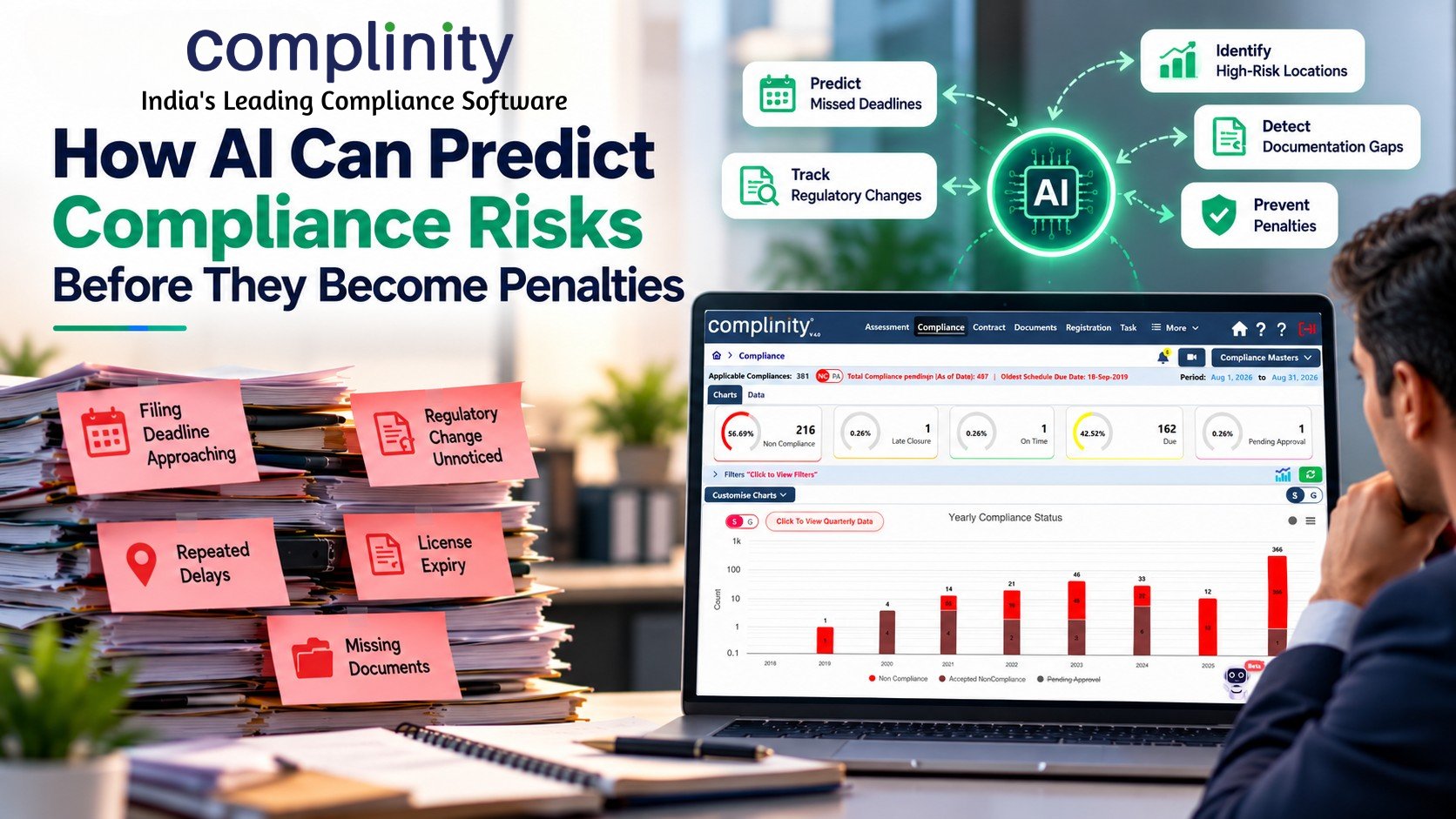
How AI Can Predict Compliance Risks Before They Become Penalties
Why Most Compliance Failures Are Predictable
Most compliance penalties don’t happen overnight.
They are usually the result of warning signs that were missed, ignored, or discovered too late.
A filing deadline is approaching but no action has been initiated. A regulatory amendment impacts existing compliance obligations but remains unnoticed. A location repeatedly misses compliance submissions. A critical license is nearing expiry without renewal action.
The reality is that compliance failures often leave clues long before regulators issue notices or penalties.
The challenge is identifying those clues early enough to act.
This is where Artificial Intelligence (AI) is changing compliance management by helping organizations predict compliance risks before they become costly violations.
The Problem with Reactive Compliance Management
Many organizations still operate in a reactive compliance environment.
The process often looks like this:
Compliance missed → Notice received → Investigation begins → Corrective action taken
By the time the issue is discovered, the organization is already dealing with:
- Regulatory scrutiny
- Financial penalties
- Operational disruption
- Reputation damage
The problem isn’t the lack of effort from compliance teams.
The problem is that traditional compliance systems focus on tracking completed activities rather than identifying emerging risks.
Compliance management should not start after a problem occurs.
It should start before the problem becomes visible.
How AI Predicts Compliance Risks
AI-powered Compliance Management Software can analyze compliance data, patterns, deadlines, and historical activities to identify risks before they escalate.
Instead of simply recording compliance activities, AI helps organizations anticipate potential issues.
1. Identifying Overdue and High-Risk Activities
AI can continuously monitor compliance obligations and identify tasks that are likely to miss deadlines based on current progress.
This allows compliance teams to intervene before a violation occurs.
2. Detecting Repeated Compliance Delays
When certain departments, locations, or business units repeatedly delay compliance activities, AI can recognize the pattern and flag potential risks.
This helps management address root causes before penalties arise.
3. Monitoring Regulatory Changes
One of the biggest causes of non-compliance is failing to respond to regulatory updates.
AI can track legal changes, assess relevance, and notify stakeholders about obligations that may require immediate action.
4. Tracking License and Permit Expirations
Expired licenses, registrations, certifications, and approvals are common compliance failures.
AI-powered systems can identify upcoming expirations and generate alerts well before renewal deadlines.
5. Highlighting Documentation Gaps
Missing records often become a major issue during audits and inspections.
AI can identify incomplete documentation and help organizations maintain audit-ready compliance records.
Real Compliance Risks AI Can Identify
Consider a few common scenarios.
Scenario 1: Missed Labour Law Filing
A factory location repeatedly submits compliance documents late.
AI identifies the trend, flags the location as high-risk, and escalates the issue before statutory deadlines are missed.
Scenario 2: Regulatory Amendment Impact
A new regulatory notification introduces additional reporting requirements.
AI identifies affected compliance obligations and alerts the relevant teams to take action.
Scenario 3: Expiring Environmental Consent
An environmental permit is due for renewal in 60 days.
Instead of relying on manual tracking, AI generates reminders and escalation alerts to ensure timely renewal.
Scenario 4: Audit Readiness Risk
Critical compliance evidence is missing from multiple locations.
AI identifies documentation gaps early, allowing teams to prepare before an audit begins.
In each case, the risk existed before the violation occurred.
The difference is that AI helped identify it sooner.
Why Predictive Compliance Matters
The future of compliance management is not just automation.
It is prediction.
Organizations that can identify compliance risks before regulators do gain significant advantages:
- Reduced penalties
- Better audit readiness
- Faster response to regulatory changes
- Improved accountability
- Stronger governance
Predictive compliance also enables compliance teams to focus on risk management rather than constantly chasing deadlines and paperwork.
Instead of asking:
“What went wrong?”
Organizations can start asking:
“What could go wrong next?”
That shift fundamentally changes how compliance is managed.
Key Takeaways
- Most compliance failures show warning signs before penalties occur.
- Traditional compliance systems are often reactive rather than proactive.
- AI helps identify compliance risks through pattern analysis, monitoring, and predictive insights.
- Compliance Management Software improves visibility into emerging compliance issues.
- Predictive compliance enables organizations to address risks before they become violations.
FAQs
What is predictive compliance?
Predictive compliance uses AI and data analysis to identify potential compliance risks before violations occur.
How does AI identify compliance risks?
AI analyzes compliance activities, deadlines, historical patterns, regulatory updates, and documentation status to detect potential risks.
Can AI prevent compliance penalties?
AI cannot eliminate all compliance risks, but it can help organizations identify and address issues before they result in penalties.
What types of compliance risks can AI detect?
Missed deadlines, recurring delays, regulatory update impacts, license expirations, and documentation gaps are common examples.
Why is predictive compliance important?
It helps businesses reduce penalties, improve governance, and respond proactively to emerging compliance challenges.
How does Compliance Management Software support predictive compliance?
It centralizes compliance data, automates monitoring, and provides visibility into potential compliance risks.
Which industries benefit most from predictive compliance?
BFSI, healthcare, manufacturing, pharmaceuticals, energy, retail, and other highly regulated industries.
Final Thought
The most effective compliance teams are no longer waiting for problems to appear.
They are using technology to identify risks before regulators, auditors, or customers ever notice them.
AI-powered Compliance Management Software is helping organizations move beyond compliance tracking toward compliance intelligence-where potential issues are identified early, action is taken faster, and penalties become far less likely.
Because the best compliance risk is the one that gets resolved before it becomes a violation.
Contact us
Complinity, India’s Leading Compliance Management Software, helps companies manage their statutory and regulatory compliances on a secure software platform.
We are currently serving companies like Max Hospital, JBM Group, TVS Credit, DCM Shriram, Oberoi Hotel, M3M apart from 1500+ Companies across 100+ industry verticals.
If you wish to know more how Complinity can help your organization minimize non-compliance risks, click the link below.

 Thank You for your interest in Complinity. Your CV has been forwarded to HR.