

Key SEBI Regulations and impact of Non-Compliance
The Securities and Exchange Board of India (SEBI) has established the Listing Obligations and Disclosure Requirements (LODR) Regulations, 2015, to ensure transparency, accountability, and robust corporate governance among listed entities in India. These regulations delineate specific responsibilities and disclosure mandates that listed companies must adhere to, thereby fostering investor confidence and maintaining market integrity. Key provisions within these regulations address various aspects of corporate governance, including the composition and duties of the board of directors, the formation and function of audit committees, and the requirements for financial reporting and disclosure. By complying with these regulations, listed entities contribute to a fair and efficient securities market, aligning with global best practices.
Here is a summary of the key SEBI LODR regulations:
- Appointment of CS: Regulation 6(1) requires the appointment of a qualified company secretary as the compliance officer. Non-compliance results in a fine of ₹1,000 per day.
- Share transfer agent: Regulation 7(1) requires listed entities to appoint a share transfer agent. Failure to do so leads to a fine of ₹1,000 per day.
- Grievance Redressal Mechanism: Regulation 13(3) requires Listed entities to file with the recognized stock exchange(s) on a quarterly basis a statement detailing the redressal of investor grievances. This statement should be filed within the timelines specified by the Board. Failure to submit within the stipulated period can lead to a fine of ₹1,000 per day.
- Board of Directors: Regulation 17 This outlines the composition, roles, and responsibilities of the board of directors for listed entities. It mandates a balanced mix of executive and non-executive directors, including independent directors, to ensure effective governance. The regulation also specifies the minimum number of board meetings and the quorum required. Non-compliance can result in a fine of ₹5,000 per day.
- Appointment of Non-Executive Directors aged 75 Years or above: Regulation 17(1A) requires that a listed entity cannot appoint or continue the directorship of a non-executive director who has attained the age of seventy-five years unless a special resolution is passed to that effect. The explanatory statement annexed to the notice for such motion must indicate the justification for appointing such a person.
- Board Meetings: Regulation 17(2) requires the board of directors to meet at least four times a year, with a maximum interval of 120 days between meetings. Non-compliance leads to a fine of ₹10,000 per instance.
- Quorum Regulation 17(2A) specifies the quorum for board meetings, requiring one-third of the total strength or three directors, whichever is higher, including at least one independent director. Non-compliance results in a fine of ₹10,000 per instance.
- Audit Committee Regulation 18mandates the formation of an audit committee with a minimum of three directors, two-thirds of whom should be independent directors. The committee’s responsibilities include overseeing the financial reporting process, reviewing audit reports, and ensuring the adequacy of internal control systems. Non-compliance can attract a fine of ₹2,000 per day.
- Nomination and Remuneration Committee: Regulation 19(1) and 19(2) require the formation of a Nomination and Remuneration Committee with a minimum of three directors, all non-executive, and at least half being independent. Non-compliance attracts a fine of ₹2,000 per day.
- Stakeholders Relationship Committee: Regulation 20(2) obligates listed entities to establish a Stakeholders Relationship Committee chaired by a non-executive director. Non-compliance leads to a fine of ₹2,000 per day.
- Risk Management Committee: Regulation 21(2) mandates listed entities to constitute a Risk Management Committee. Non-compliance can result in a fine of ₹2,000 per day.
- Related Party Transactions: Regulation 23(9) mandates disclosure of related party transactions on a consolidated basis within 30 days from the publication of financial results. Non-compliance attracts a fine of ₹5,000 per day.
- Regulation 24(A): Secretarial Audit requires every listed entity and its material unlisted subsidiaries incorporated in India to undertake a secretarial audit and annex a secretarial audit report with the annual report. This ensures compliance with applicable laws and regulations. Specific penalties are not detailed in the available sources; non-compliance may lead to actions as deemed appropriate by SEBI.
- Other Corporate Governance Requirements: Regulation 27(2) requiresListed entities to submit a quarterly compliance report on corporate governance to the recognized stock exchange(s) within fifteen days from the close of each quarter. This report should be signed either by the compliance officer or the chief executive officer of the entity. Failure to submit within the prescribed period may lead to a fine of ₹2,000 per day.
- Approval for issuing securities: Regulation 28(1) requires listed entities to obtain in-principle approval from stock exchanges before issuing securities. Non-compliance results in a fine of ₹50,000 per instance.
- Intimation to Stock Exchanges: Regulation 29(2) and 29(3) stipulates prior intimation to stock exchanges about board meetings concerning specific matters like financial results. Delays incur a fine of ₹10,000 per instance.
- Holding of Specified Securities and Shareholding Pattern Regulation 31 requires Listed entities must submit to the stock exchange(s) a statement showing the holding of securities and shareholding pattern separately for each class of securities. This statement should be submitted on a quarterly basis, within twenty-one days from the end of each quarter. Non-submission may incur a fine of ₹2,000 per day.
- Reclassification of promoters as public shareholders: Regulation 31A(3)(a) relates to the procedure for reclassification of promoters as public shareholders, including timely submission of applications to stock exchanges. Delays incur a fine of ₹5,000 per day.
- Financial Results: Regulation 33 specifies the requirements for the preparation, approval, and submission of financial results by listed entities. It mandates that the quarterly and annual financial results be submitted to the stock exchange(s) and published in the prescribed manner. Delay or non-submission can result in a fine of ₹5,000 per day.
- Annual Report: Regulation 34 requires Listed entities to submit the annual report to the stock exchange(s) and publish it on their website on or before the day of commencement of dispatch to its shareholders. The annual report should include audited financial statements, cash flow statements, directors’ reports, and other specified disclosures. Non-submission within the prescribed period can result in a fine of ₹2,000 per day.
- Investigation of complaints on substantial acquisition of shares and takeovers: Regulation 38 of the Securities and Exchange Board of India (Substantial Acquisition of Shares and Takeovers) Regulations, 1997, empowers SEBI to appoint one or more investigating officers to conduct investigations for specific purposes, including:
- Investigating complaints from investors, intermediaries, or others concerning substantial acquisition of shares and takeovers.
- Initiating suo-moto investigations based on its own knowledge or information, in the interest of the securities market or investor interests, for any breach of the regulations.
- Determining whether the provisions of the Act and the regulations are being complied with.
This regulation grants SEBI the authority to ensure compliance and protect investor interests in matters related to substantial acquisition of shares and takeovers.
- Book closure and Record Date: Regulation 42(2), 42(3), 42(4), and 42(5) pertains to the disclosure and timing of record dates and book closure dates for dividends and other corporate actions. Non-compliance attracts a fine of ₹10,000 per instance.
- Dividend Distribution Policy: Regulation 43A mandates the top 500 listed entities to formulate a Dividend Distribution Policy and disclose it in their annual reports and on their websites. Non-disclosure results in a fine of ₹25,000 per instance.
- Submission of voting results: Regulation 44(3) obligates submission of voting results to stock exchanges within 48 hours of a general meeting. Non-compliance incurs a fine of ₹10,000 per instance.
- AGM: Regulation 44(5) requires listed entities to hold their annual general meeting within five months from the end of the financial year. Non-compliance leads to a fine of ₹25,000 per instance.
- Submission of Audit Reports: Regulation 55A requires companies to submit quarterly audit reports to stock exchanges. These reports are used to reconcile the total issued capital, listed capital, and capital held in dematerialized form.
For more information, visit: nsearchives.nseindia.com
SEBI’s rigorous enforcement of Non-Compliance Penalties
The Securities and Exchange Board of India (SEBI) has consistently demonstrated a stringent approach toward enforcing penalties for non-compliance, underscoring its commitment to maintaining market integrity. In a notable instance, SEBI imposed a ₹15 lakh fine on Mishtann Foods Ltd for failing to promptly address investor grievances, highlighting the regulator’s intolerance for lapses in investor protection. (Source: TimesOfIndia)
Similarly, individuals have faced substantial penalties for disregarding SEBI’s directives; for example, Purshottam Khandelwal was fined ₹10 lakh for not complying with an order to disgorge unlawful gains. (Source: Indian Express)
SEBI’s rigorous enforcement extends to high-profile cases as well, as evidenced by the five-year ban and ₹25 crore fine imposed on businessman Anil Ambani and others for fund diversion activities. (Source: Reuters)
These actions reflect SEBI’s unwavering dedication to upholding regulatory compliance and deterring malpractices within India’s securities markets.
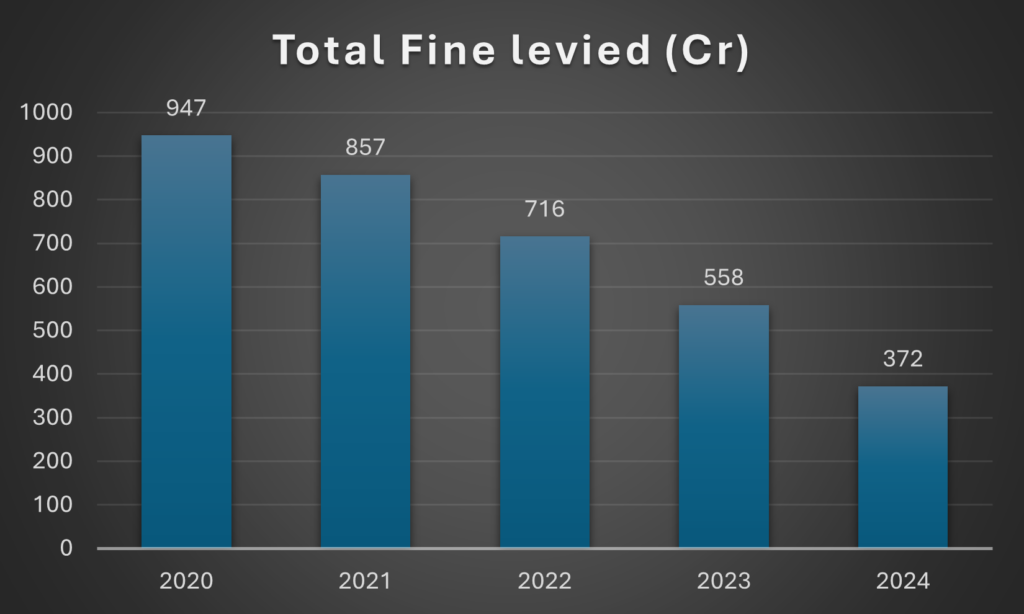
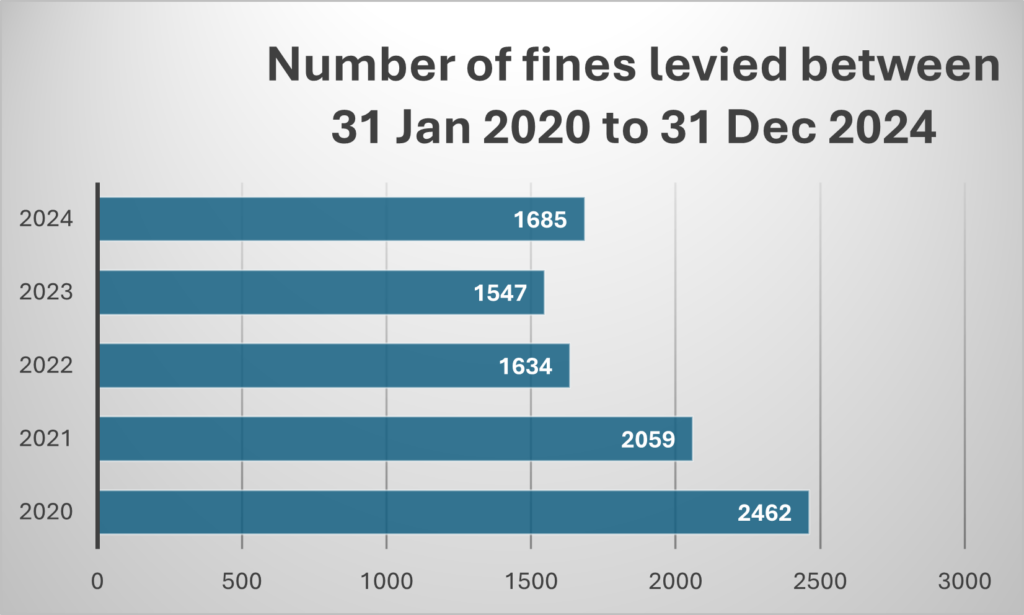
The above graphs show that although the total amount of non-compliance penalties has been decreasing significantly, SEBI as a regulator has been strict in enforcing regulations with heavy fines. Annual trend of number of companies being fined has also reduced but the number of non-compliant companies is still significantly high keeping in mind there are only a few thousand listed entities in India. The reason for drop could be because of strict enforcement by the regulator and higher adoption of tech enabled compliance management solution like Complinity. The companies are increasingly aware of the risks of noncompliance and it’s impact on their stock valuation and reputation
Talk to Our Experts
Ready to make the shift to a streamlined compliance strategy? Talk to our experts and see how we can help your business stay ahead of the curve!

 Thank You for your interest in Complinity. Your CV has been forwarded to HR.