

From Compliance to Impact: Navigating the Next Decade of CSR in India
For over a decade, Section 135 of the Companies Act 2013 has mandated that specific Indian companies spend 2% of their average net profits on social responsibility. While this started as a regulatory obligation, many organizations have struggled to move beyond a “checkbox” approach to compliance. The core problem is the gap between spending money and creating a meaningful, long-term social impact. As the legal landscape shifts and stakeholders demand more accountability, the challenge for modern businesses is to transform CSR from a siloed department into a core strategic business objective.
The Strategic Shift: From CSR 1.0 to CSR 2.0
In the early years of the mandate, CSR was often characterized by writing checks to charities, sponsoring one-off events, or occasional employee volunteering to bolster a public image. However, since 2020, we have entered an era of CSR 2.0, where social initiatives are deeply integrated into business operations, supply chain management, and product innovation.
The distinction between CSR and ESG (Environmental, Social, and Governance) is critical to this evolution. While CSR is essentially a promise to do good backed by regulation, ESG represents how a company delivers on that promise through measurable goals and ethical operationalization. CSR focuses on what a company does for society, whereas ESG defines the sustainable and ethical methods used to achieve those results.
Measuring True Impact: Why You Must “Fix the Soil”
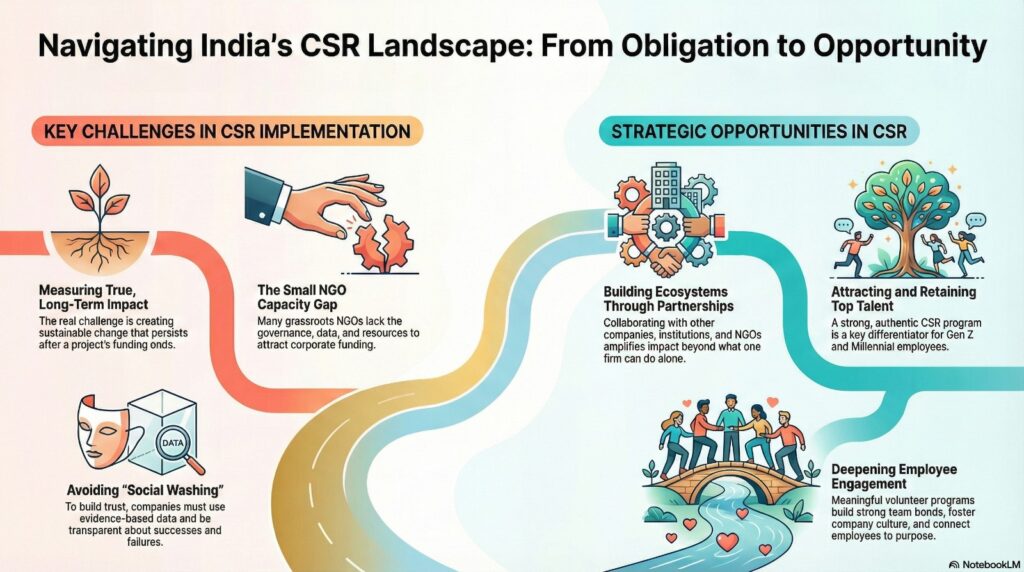
A recurring theme in the webinar was the difference between short-term outcomes and long-term systemic change. Measuring impact is not just about counting the number of beneficiaries or the total amount of money spent; it is about ensuring that a program survives after the corporate funding exits.
Key strategies for measuring and achieving impact include
The “Fix the Soil” Approach: Before launching a project, organizations must address underlying foundational issues. For example, in a tree plantation project, soil fixation must happen before planting, or the trees will not survive; similarly, in education, you must monitor the entire ecosystem, such as school holidays and weather events, rather than just learning levels.
Sustainability and Exit Strategies: True impact is achieved when an intervention makes an individual or institution self-sustaining. A successful project should be able to run independently two to five years after the company has exited.
Holistic Intervention: Rather than just funding a single service, such as a surgery, companies should look at upskilling doctors and upgrading hospital equipment to create a scalable, regional facility.
Avoiding the Pitfalls of Greenwashing and Social Washing
With increased pressure from investors and consumers—particularly Gen Z and millennials who prefer brands with authentic ethical stances—companies face the risk of greenwashing or social washing. This occurs when organizations create statistics or narratives that are “marketable” but lack substance or ethical grounding.
To mitigate these risks, companies should do the following.
Use evidence-based data and authentic, precise language.
- Set SMART goals (Specific, Measurable, Achievable, Relevant, and Time-bound) that are auditable.
- Ensure transparency by reporting both successes and failures; failing fast and learning is better than “bleeding” on a project that doesn’t work.
- Maintain supply chain transparency and ensure that internal practices, such as fair wages and employee safety, mirror the public-facing CSR image.
- Empowering the NGO Ecosystem: From Fundable to Findable
A significant hurdle for many companies is finding legitimate NGO partners that align with their values. While large “brand-name” NGOs are well-funded, smaller grassroots organizations often lack the organizational muscle and governance structures to attract corporate grants. Therefore NGOs must move from being merely “fundable” to being “findable”.
This requires a focus on:
- Good Governance: Establishing core compliances, bookkeeping, and transparent reporting structures.
- Technical Know-how: Leveraging technology and AI to become more efficient, even under resource constraints.
- Compelling Communication: The ability to present a long-term vision and clear impact data to potential funders.
For smaller companies with resource constraints or cash flow issues, utilizing the unspent account allows them to commit funds during profitable years and spend them gradually over time. Additionally, partnering with mid-size foundations can provide the ground-level expertise needed to run a meaningful program without needing a massive internal team.
Final Thoughts
CSR is no longer just about compliance or “doing business with a soul”; it is about creating integrated, sustainable value. As thresholds for mandatory spending potentially lower, more companies will enter the ecosystem, making it even more vital to focus on strategic partnerships and governance. By moving away from siloed activities and toward a holistic view of the social and environmental ecosystem, businesses can ensure that their contributions lead to a “life well-lived” for the communities they serve.
Contact us
Complinity, India’s Leading Compliance Management Software, helps companies manage their statutory and regulatory compliances on a secure software platform.
We are currently serving companies like Yes Bank, Panasonic, Amara Raja, Toyota, Max healthcare, UB Group, Oberoi Group and Brookfield Renewable apart from 1500+ Companies across 100+ industry verticals.
If you wish to know more how Complinity can help your organization minimize non-compliance risks, click the link below.

 Thank You for your interest in Complinity. Your CV has been forwarded to HR.