

Electoral Bonds: Transparency Wins India’s Political Funding Battle
In the milieu of India’s political arena, electoral funding has long been a subject of contention, with transparency and accountability often getting side-lined. At the heart of the recent debate about Electoral Bonds scheme lies the issue to transparency in political funding and ensuring free and fair election process.
Electoral Bonds were introduced by the Indian Government in 2017. The scheme allowed individuals and corporations to purchase bonds from designated banks and donate them to political parties of their choice. Ostensibly, this mechanism aimed to curb the use of black money in elections and enhance transparency by channelising donations through banking channels.
However, recent developments have brought this scheme under intense scrutiny, shedding light on its flaws and raising questions about its efficacy in upholding democratic principles.
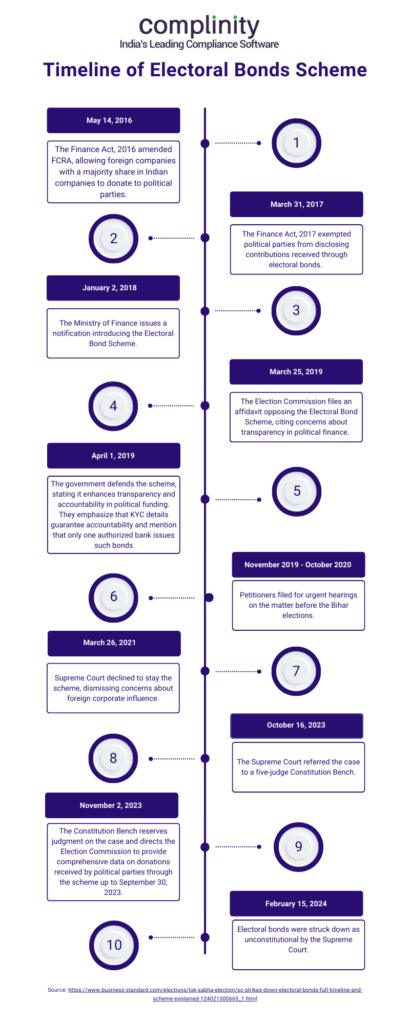
The Evolution of Electoral Bonds: Amendments and Implications
In its nascent stage, Electoral Bonds required foundational changes to the Companies Act 2013. Government’s proposal involved amending Section 182 to accommodate the issuance and redemption of these bonds.
The Finance Act, 2016 paved the way for foreign companies with a majority stake in Indian entities to contribute to political parties. This amendment to the Foreign Contribution Regulation Act (FCRA) opened the doors for foreign capital to influence domestic political landscapes, raising questions about the integrity of the electoral process.
Subsequently, the Finance Act, 2017 brought about significant changes to the regulatory framework surrounding electoral bonds. One of the key amendments exempted political parties from disclosing the contributions received through these bonds, effectively shrouding the sources of funding in anonymity.
Furthermore, Section 31 of the Reserve Bank of India (RBI) Act was amended, granting the Union government the authority to “authorise any scheduled bank to issue electoral bond[s].” This move authorized the issuance and management of electoral bonds, raising concerns about potential conflicts of interest and the concentration of power.
Prior to these amendments, Section 182 of the Companies Act imposed specific conditions on corporate donations to political parties. Companies were required to be at least three years old and could donate up to 7.5 percent of their average net profits during the three immediately preceding financial years. Moreover, they were obligated to disclose the amount and the name of the recipient party , ensuring a degree of transparency in corporate contributions.
However, the amendments introduced by the Finance Act, 2017 effectively abolished these conditions, removing the transparency requirements and potentially opening the door for unchecked corporate influence in the political arena.
Electoral Bonds: Scrutinizing the Path to Transparency
The electoral bonds scheme has faced criticism from various stakeholders, including opposition parties and civil society organizations, regarding its perceived lack of transparency. Concerns have been raised about the potential for misuse and the concentration of political funding to select influential political parties.
The central criticism levelled against the electoral bonds scheme is that it does the exact opposite of what it was intended to achieve: bring transparency to election funding. Critics argue that while the anonymity of electoral bonds is meant for the broader public and opposition parties, the government of the day maintains the ability to access information about the donors through the State Bank of India (SBI), the sole issuer of these bonds. This knowledge, critics argue, allows for the possibility of extortion or victimization, particularly targeting large corporations. The potential for the ruling party to either demand funds or retaliate against those who do not support them financially raises concerns about an unfair advantage and the erosion of a level playing field.
The Indian Supreme Court has long held that the “right to information,” especially in the context of elections, is an integral part of the right to freedom of expression enshrined in Article 19 of the Indian Constitution. The anonymity surrounding electoral bonds effectively curtails this fundamental right, denying citizens access to crucial information that could influence their electoral choices.
While electoral bonds provide no details to citizens, the anonymity does not apply to the government of the day, which can always access donor details by demanding the data from the SBI. This asymmetry of information implies that the government in power can leverage this knowledge and potentially disrupt the conduct of free and fair elections, compromising the integrity of the democratic process.
The electoral bonds scheme removes all pre-existing limits on political donations and effectively allows well-resourced corporations to fund elections without restrictions. This paves the way for crony capitalism, an economic system characterized by close, mutually advantageous relationships between business leaders and government officials. Such a scenario raises concerns about the undue influence of moneyed interests on policymaking and governance.
Ultimately, the success of any initiative lies in its ability to withstand scrutiny and adapt to emerging challenges. The electoral bonds scheme, while well-intentioned, must be subjected to rigorous examination and necessary reforms to ensure that it aligns with the core values of transparency, accountability, and the preservation of a vibrant and equitable democratic system.
The Supreme Court’s Verdict: A Balanced Approach
The Supreme Court’s landmark judgment provided clarity and addressed concerns raised by various stakeholders, including opposition parties and civil society organizations.
While striking down the Electoral Bonds scheme, acknowledging its potential to curb the inflow of unaccounted funds into political financing, the Supreme Court emphasized the need for greater transparency and accountability measures. The court’s observations reflected a nuanced and balanced approach, aimed at preserving the core objectives of the scheme while addressing its shortcomings.
In a significant move, the Supreme Court declared Section 182(3) of the Companies Act, amended by Section 154 of the Finance Act 2017, as unconstitutional. This provision, which had previously allowed for unlimited corporate contributions to political parties, was deemed violative of Article 19(1)(a) (the right to freedom of speech and expression) and Article 14 (the right to equality).
Consequently, the court’s ruling has brought about a paradigm shift in the landscape of corporate political contributions. Companies must now adhere to the following guidelines:
1. Contributions to a political party (either directly or through an Electoral Trust) in any financial year should not exceed 7.5% of the average net profits during the three immediately preceding financial years.
2. Details of the names of the political parties and the amounts contributed must be disclosed in the Profit and Loss account.
3. Companies are prohibited from participating in any Electoral Bond scheme.
Conclusion: Charting a Path Forward
As India continues its democratic journey, the issue of electoral funding remains a critical aspect of governance and accountability. Electoral Bond was a step towards reforming political financing, but their effectiveness hinges on robust legal frameworks and transparent mechanisms. With amendments to the Companies Act 2013 and the Supreme Court’s observations in 2024, there is a renewed impetus to navigate the complexities of electoral finance and uphold the democratic ethos of transparency, integrity, and accountability. As stakeholders engage in dialogue and deliberation, it is essential to chart a path forward that fosters trust in the electoral process and strengthens democratic institutions for the benefit of all citizens.
While Electoral Bonds held the promise of streamlining the flow of funds into the political arena and promoting transparency, their true efficacy hinges on a robust regulatory framework and vigilant judicial oversight. The legal amendments surrounding these bonds, coupled with the Supreme Court’s verdict has laid the foundation for a more equitable and accountable system, but also raised concerns that demand careful consideration.
At the heart of this discourse lies the fundamental principle of upholding the integrity of India’s democratic fabric. Ensuring that the voices of all citizens are heard and represented in the political process is paramount. As such, it is imperative that stakeholders from across the ideological spectrum engage in constructive dialogue and work collaboratively to navigate the complexities of electoral finance.

 Thank You for your interest in Complinity. Your CV has been forwarded to HR.